Colonial Architecture.

vast and wonderful structures, the beautiful orders which were to them the very alphabet of art.
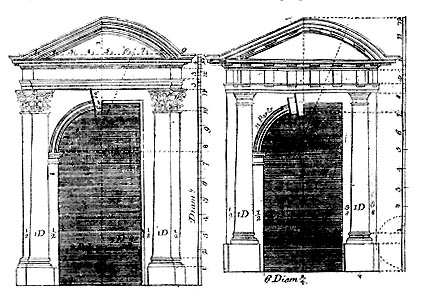
      The old time merchant princes of Salem and Boston and Portsmouth and the prosperous planters of the Genesee Valley and of Maryland and Virginia were not Roman emperors, and they had no Greek architects to ornament their square, comfortable and altogether homelike dwellings; but they had intelligent builders who were comparatively honest; and the builders had books, both home-made and foreign. These books alone sufficiently account for the origin, development and characteristics of American colonial architecture. There was one book published in Boston about the time of the Revolution: "The Town and Country Builder's Assistant," by J. Norman, Architect, the introduction to which is worth quoting. After the encouraging assurance that the plates and text are "made familiar to the meanest capacity," the author says:

"The greatest Pleasure that builders and workmen of all kinds have of late years taken in the study of Architecture, and the great Advantages that have accrued to those for whom they have been employed, by having their work executed in a much neater and more magnificent Manner than was ever done in this Country before, has been the real Motive that induced me to the Compiling of this Work for their future Improvement. Besides as the study of Architecture is truly delightful in all its processes, its practise is evidently of the greatest Importance to Artificers in general, and its rules so easy as to be acquired at leisure times, when the Business of Day is over by way of Diversion. 'Tis a Matter of very great Surprise to me how any Person dare presume to discourage others from the Study thereof, and render them often less serviceable to the Public than so many Brutes. But to prevent this infection from diffusing its poisonous effluvias any further, and in consideration that amongst all sorts of people there are some in whom nature has implanted that noble Faculty of the soul called REASON WHEREBY WE JUDGE OF THINGS, I have therefore at very great expense compiled this work for the common good of all Men of Reason" &c., &c.


      Evidently then, as now, architects were sometimes fired with a missionary spirit, and Boston had begun to be Bostonian.
      There was a small book published at Greenfield, Mass., just a hundred years ago, by Arther Benjamin. To this, which was a thoroughly practical treatise, and to its author, who was a no less practical builder, is due by far the greater part of the good colonial architecture in western New

-- page 7 --


These pages are © Laurel O'Donnell, 2005, all rights reserved
Copying these pages without written permission for the purpose of republishing
in print or electronic format is strictly forbidden
This page was last updated on 20 Jul 2005