|
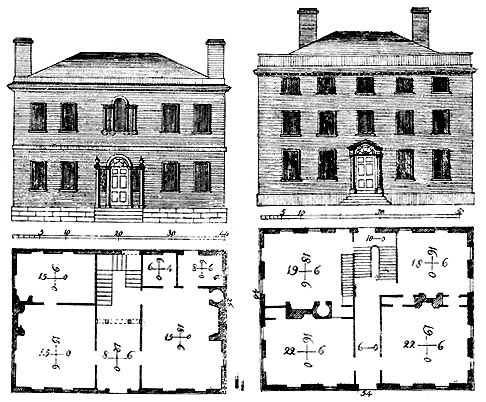
Plans Of Colonial Mansions.
These designs and those which follow are reproduced from Arthr Benjamin's "The Country Builder's Assistant," published at Greenfield, Massachusetts, 1797.
ing hood supported on brackets more or less carved and molded, sometimes a graceful portico, often a Palladian window, a sort of Lilliputian reminder of the grandeur of old Italian palaces. All of these details were affected by heredity and the period in which they were built. The English would be English still, and the Dutch, Dutch, whether in the decoration of their door ways, in their religious formalities, or the fashion of their wives' bonnets.
Edward Eggleston's remark, that "it is difficult to originate, even in a new country," has been quoted as applicable to the colonial habit of vain repetition in the matter of architecture. The substance of the remark is at least as old as Solomon, barring the "new country" clause; and of all people in the world, the pioneers of an unsubdued continent should be excused from other inventions than those born of necessity. As a matter of fact, our colonial ancestors, like everybody else, invented when they must, and imitated and appropriated when they could. But the adaptations to their needs and conditions of the forms which they chose to imitate sometimes amounted almost to original design, confirming the truth that, whatever the material, mental or moral condition of man may be, he constantly strives to gratify his love for the beautiful, — it may be in architecture, sculpture, painting, music or literature.
What the earlier colonial architects did, — for there seem to have been a few real architects even in the last of the seventeeth century, — and especially what the builders did, was to take such details as were delineated in their books and adapt them to the
-- page 10 --
|